On the morning of May 22, the 41st lecture of the "Cooperation and Development" Series was successfully held at the Qingdao Campus of Shandong University. The event was jointly hosted by the School of Political Science and Public Administration, the Institute of Shanghai Cooperation Organization, the Institute of Public Security, and the China-SCO School of Economics and Trade of Shandong University.
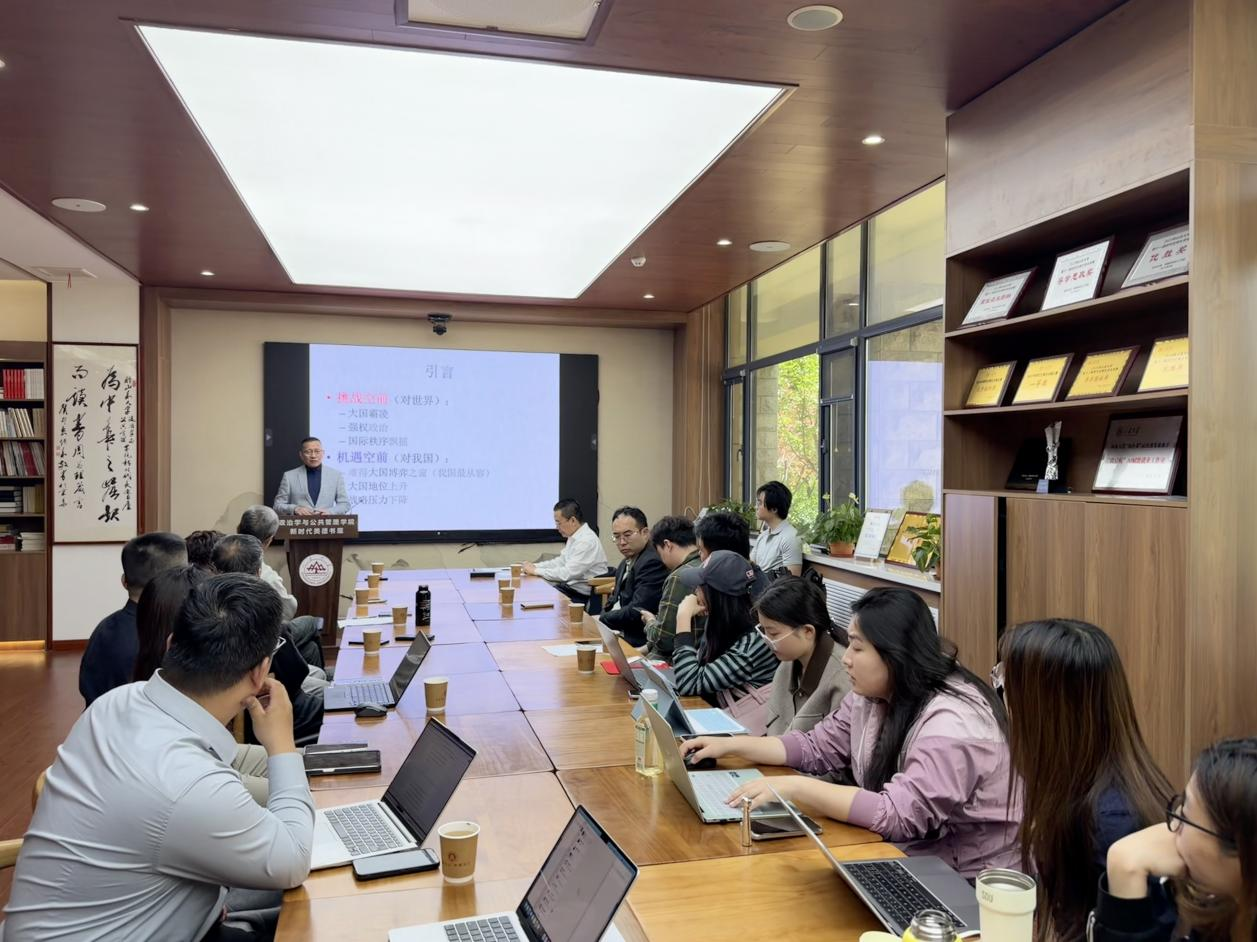
Professor Lin Hongyu, Member of the Standing Committee of the Party Committee, Vice President of Huaqiao University, and Distinguished Professor of Political Science and International Relations, was invited as the keynote speaker. The lecture was themed The Impact of Current Major Power Relations and International Security Situation on China’s Peaceful Rise. Edmund Sheng Li, Distinguished Professor and Executive Director of the Institute of Shanghai Cooperation Organization, presided over the event. Teachers, students and think tank experts from relevant disciplines attended the academic exchange.
Against the backdrop of profound adjustments in the global landscape, Professor Lin Hongyu adopted a traditional dichotomy perspective and delivered an in-depth sharing with historical depth and strategic insight, focusing on the challenges and opportunities embedded in the current international situation. In analyzing the global geopolitical pattern, Professor Lin noted that certain major powers have resorted to power politics and irresponsible behaviors, which stand in sharp contrast to China’s commitment to upholding major-country responsibility and safeguarding multilateralism with strategic wisdom.
The Western bloc is undergoing drastic structural loosening and disintegration, while the cohesive forces led by non-Western countries are emerging as a new driving force reshaping the international order.
At the beginning of the lecture, Professor Ma Ben, Dean of the School of Political Science and Public Administration, extended a sincere welcome and gratitude to Professor Lin Hongyu. During the interactive session, teachers, students and participating experts engaged in academic discussions with Professor Lin on hot topics including theories of overseas interest protection and Global South governance.
In his concluding remarks, Edmund Sheng Li commented that Professor Lin’s lecture features both a broad global strategic vision and incisive case studies at the micro level. It not only clarified the evolutionary logic of major power relations since China’s reform and opening up, but also provided an enlightening demonstration for faculty and students to broaden their research horizons in international relations and conduct think tank research with both academic value and policy advisory significance.
The lecture offered a valuable opportunity for teachers and students to engage in face-to-face exchanges with leading experts in international relations. It has injected new impetus for faculty and students to explore confidently and pursue innovation on their academic paths in the future.