On the morning of December 23, the 36th session of the "Cooperation and Development" lecture series was successfully held at the Qingdao Campus. Co-hosted by the School of Political Science and Public Administration, SCO Research Institute, Institute of Public Security, and China-SCO Economic and Trade College of Shandong University, this session invited Professor Zhou Guiyin as the keynote speaker. Professor Zhou is a senior faculty member of the School of International Relations/Nanyang Research Institute, Xiamen University, and deputy editor-in-chief of the CSSCI journalSoutheast Asian Affairs. The theme of his lecture was "Forms and Characteristics of Global South Multilateralism". Edmund Sheng, Distinguished Professor of Shandong University, Taishan Scholar Distinguished Expert, and Executive Dean of the SCO Research Institute, presided over the lecture. Representatives of teachers and students from the School of Political Science and Public Administration attended the academic exchange.
At the opening of the lecture, Zhu Guichang, Vice Dean of the School of Political Science and Public Administration, extended sincere welcome and gratitude to Professor Zhou Guiyin.
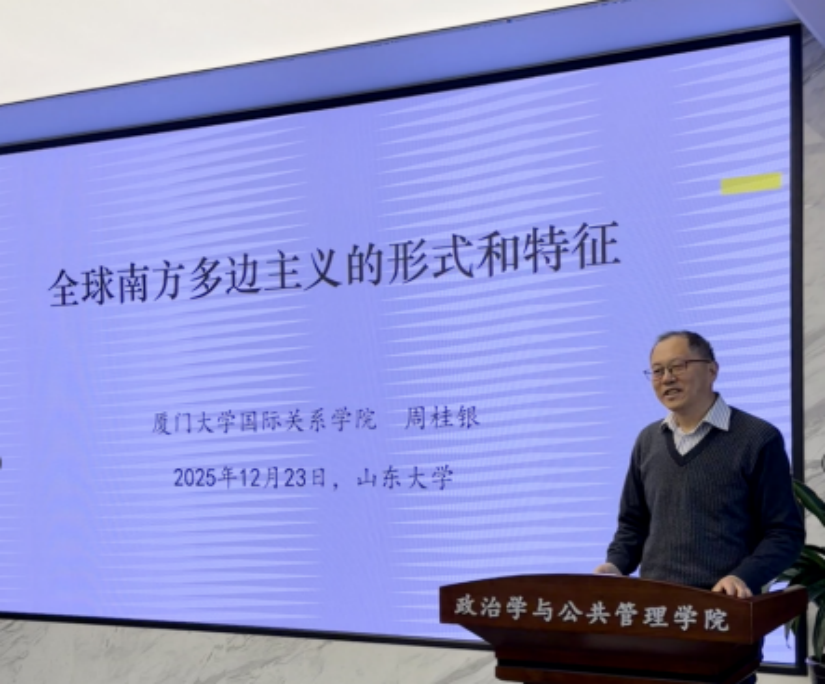
Against the grand historical backdrop of the rise of the Global South, Professor Zhou Guiyin systematically reconstructed the theoretical connotation, historical evolution and practical forms of Global South multilateralism from both temporal and spatial dimensions. He first traced the historical significance of the Bandung Conference as the starting point of Global South multilateralism, and divided its historical process into five phases based on the evolution of core missions. When analyzing the characteristics of Global South multilateralism, he put forward the highly explanatory concepts of thin institution and thick procedure. He argued that unlike the Western-led strong institutionalization model, Global South multilateralism demonstrates unique institutional resilience: it integrates flexible informal and consensus-based approaches with incremental norm-building processes, thus achieving the unity of regional autonomy and strategic coordination.
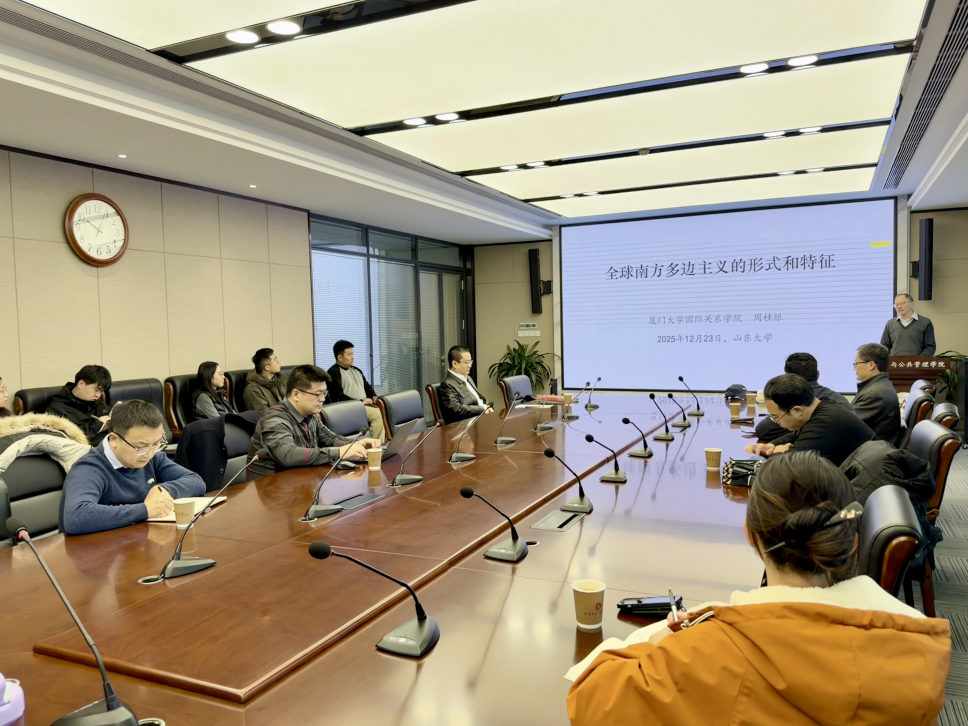
During the interactive Q&A session, teachers and students on site conducted in-depth discussions with Professor Zhou on cutting-edge issues such as the expansion effect of the BRICS mechanism. In his concluding remarks, Edmund Sheng spoke highly of Professor Zhou's academic contributions, noting that the lecture not only clarified the historical context of Global South multilateralism, but also provided a China-perspective theoretical framework for understanding the current transformation of the international order.
As an important part of the branded "Cooperation and Development" lecture series, this session, with its profound historical foundation and broad theoretical vision, offered new cognitive paths for teachers and students to understand the rise of the Global South and the transformation of the international system, and further enlivened the academic atmosphere of the school.