On the morning of December 19th, the 34th session of the "Cooperation and Development" Lecture Series was successfully held at Qingdao Campus of Shandong University. Co-hosted by the School of Political Science and Public Administration, Shanghai Cooperation Organization (SCO) Research Institute, Public Security Research Institute of Shandong University, and China-SCO Economic and Trade College, the lecture invited Professor Zhang Zhenjiang as the keynote speaker. Professor Zhang is a faculty member of the School of International Relations and the Academy of Overseas Chinese Studies at Jinan University, Director of the Key Research Base of Humanities and Social Sciences of the Ministry of Education, and Editor-in-Chief of the CSSCI journalSoutheast Asian Studies. His presentation was themed "Knowledge and Practice in the Construction of Area Studies as a First-Class Discipline". The lecture was hosted by Edmund Sheng, Distinguished Professor of Shandong University, Taishan Scholar Distinguished Expert, and Executive Dean of the SCO Research Institute. More than 20 teachers and students from the School of Political Science and Public Administration and the Law School participated in this academic exchange.
Against the backdrop of Area Studies emerging as a new first-class discipline, Professor Zhang Zhenjiang systematically shared his profound insights on the discipline's construction from two core dimensions: "scientific research" and "talent cultivation". Drawing on recent fieldwork cases in Central Asian countries such as Uzbekistan, he vividly elaborated on the "dual-perspective" methodology. Addressing the practical challenges in current discipline development, Professor Zhang emphasized the pivotal "ballast stone" role of "professional foundations" in interdisciplinary studies. He pointed out that talent cultivation in Area Studies should strive to break down "disciplinary barriers", but interdisciplinary integration must be premised on safeguarding the core of one's own professional field. Only by deeply engaging in specific disciplinary areas and mastering the languages of target countries can valuable knowledge integration and innovation be achieved.
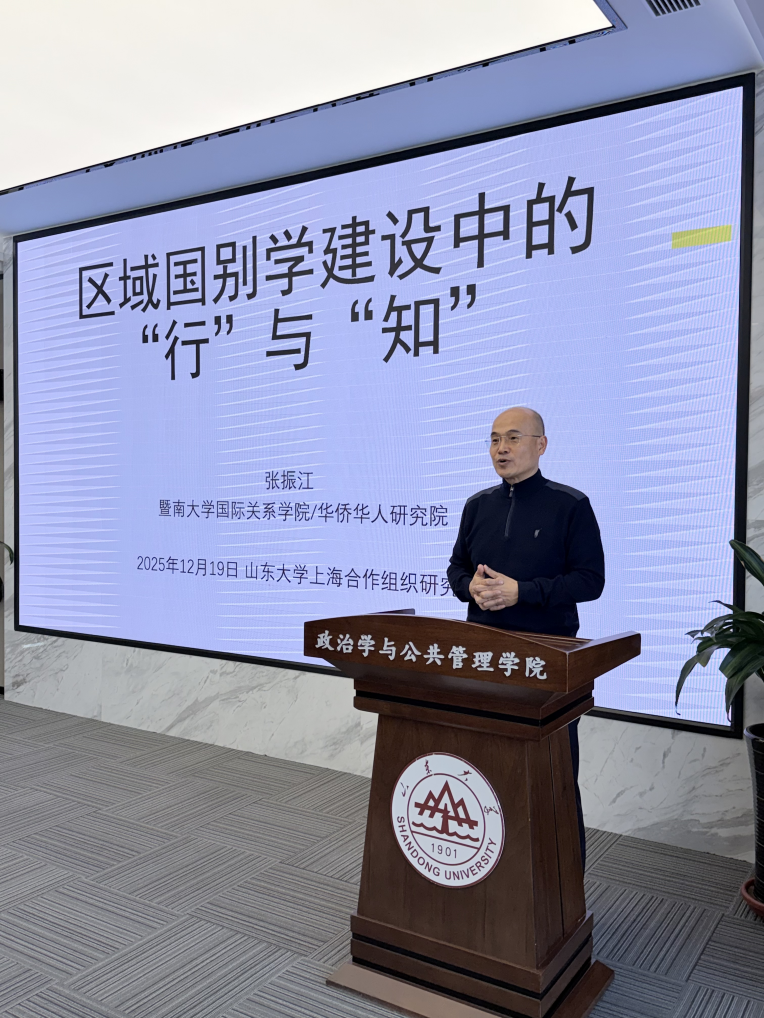
During the interactive exchange session, teachers and students engaged in in-depth discussions with Professor Zhang on hot topics including the definition of disciplinary boundaries, interdisciplinary research paths, and security and diplomacy in Central Asia. In his concluding remarks, Edmund Sheng highly praised Professor Zhang's significant contributions to the establishment of Area Studies as a first-class discipline. He noted that the lecture provided an inspiring "Chinese perspective" and "global vision" for teachers and students to deepen their understanding of the knowledge genealogy and practical paths of Area Studies.
This lecture not only broadened the academic horizons of participating teachers and students but also injected new ideas into the construction of Area Studies as a first-class discipline and the cultivation of international talents. The School of Political Science and Public Administration will continue to rely on high-end platforms such as the SCO Research Institute, gather top academic resources at home and abroad, and continuously promote the in-depth integration of interdisciplinary research with national strategies.