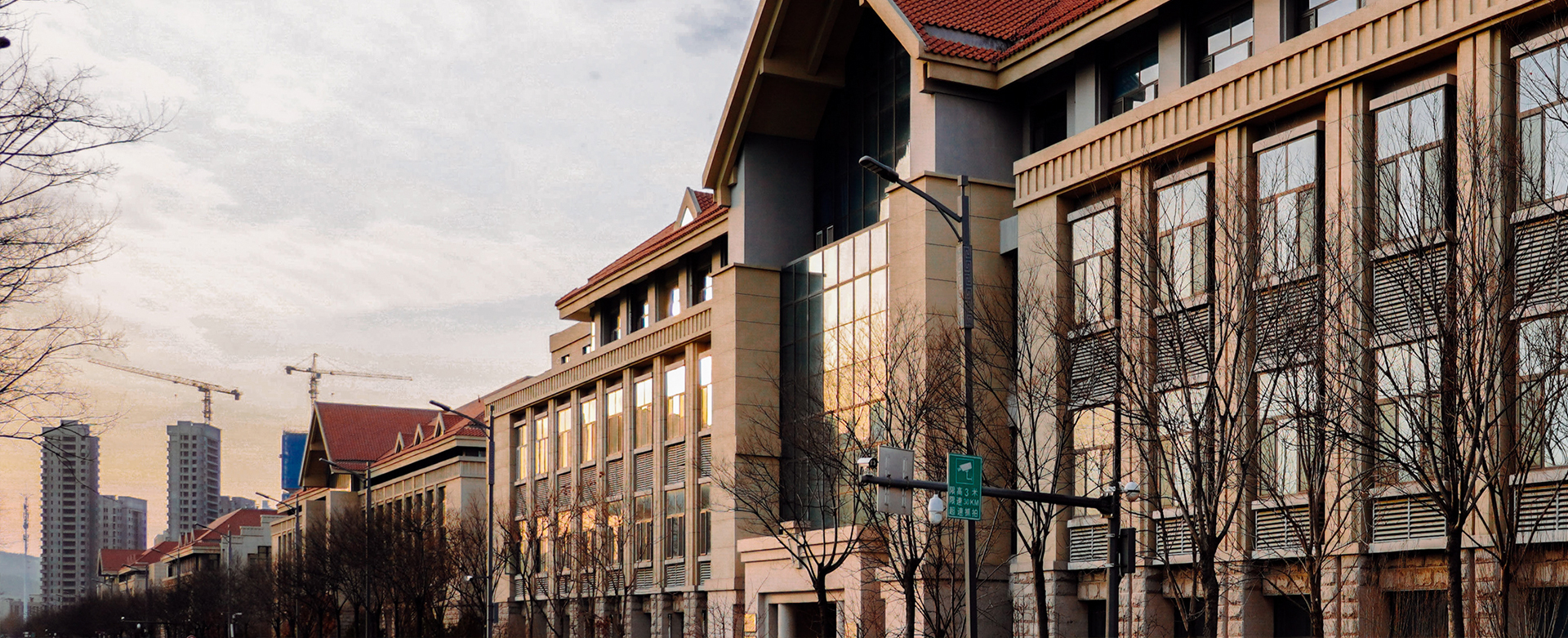
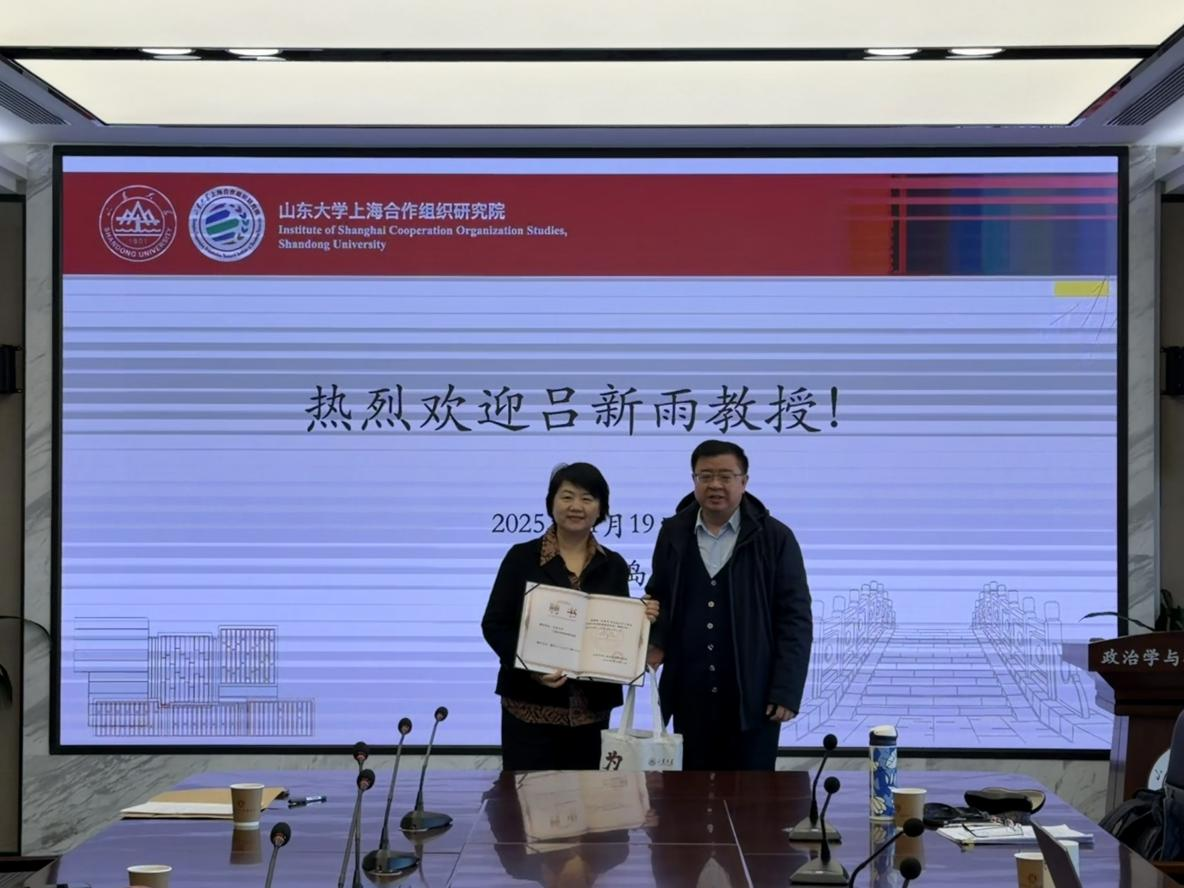
On the afternoon of November 19th, the 33rd session of the "Cooperation and Development" Lecture Series was successfully held at Qingdao Campus of Shandong University. Co-hosted by the School of Political Science and Public Administration, Shanghai Cooperation Organization (SCO) Research Institute, Public Security Research Institute of Shandong University, and China-SCO Economic and Trade College, the lecture featured the theme "The Kennan-Lippmann Debate and the 'Roots of American Behavior' in the 21st Century". The keynote speaker was Professor Lü Xinyu, Dean of the Institute of International Communication at East China Normal University and recipient of a national-level talent title. The lecture was hosted by Edmund Sheng, Distinguished Professor of the School of Political Science and Public Administration and Executive Dean of the SCO Research Institute of Shandong University, with teachers and students from the School of Political Science and Public Administration participating in the academic exchange. Prior to the lecture, Professor Ma Ben, Dean of the School of Political Science and Public Administration of Shandong University, presented Professor Lü Xinyu with the letter of appointment as a Senior Research Fellow of the SCO Research Institute of Shandong University.
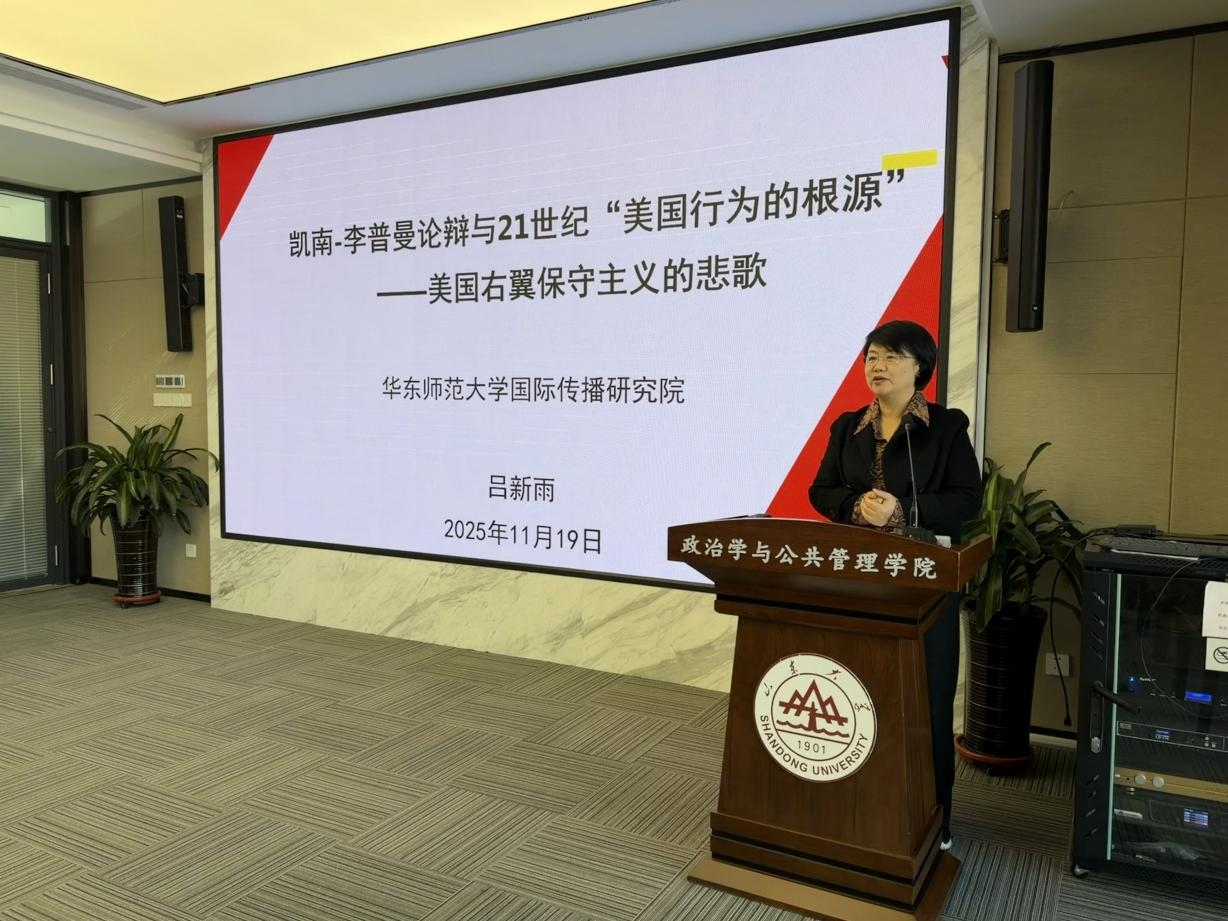
In her keynote speech, Professor Lü Xinyu took "the generative mechanism and contemporary continuity of Cold War narratives" as the entry point, systematically reviewing Lippmann's criticisms and the strategic choices of the United States in the early Cold War. She pointed out that the true origin of the Cold War did not stem from Soviet expansion, but from the persistent misreading of the Soviet Union's post-war industrialization plans by the United States and Western countries, as well as the hegemonic aspirations behind such misreading. Kennan's "theory of inherent authoritarianism" constructed an institutionalized framework of hostility toward the Soviet Union in the United States, while Lippmann's "critique of Wilsonianism" revealed the deep-seated crisis of the abuse of power in U.S. diplomacy. The ideological debate between Kennan and Lippmann, spanning more than 70 years, still retains strong explanatory power in the 21st century. Its inherent tension of "expansion vs. self-preservation" has been reactivated by U.S. right-wing conservatism, manifesting in contemporary new Cold War narratives, the logic of NATO expansion, and Russia policy. She emphasized that understanding this narrative structure is crucial for grasping the strategic behavior, discourse construction, and order-building of the United States in international affairs.
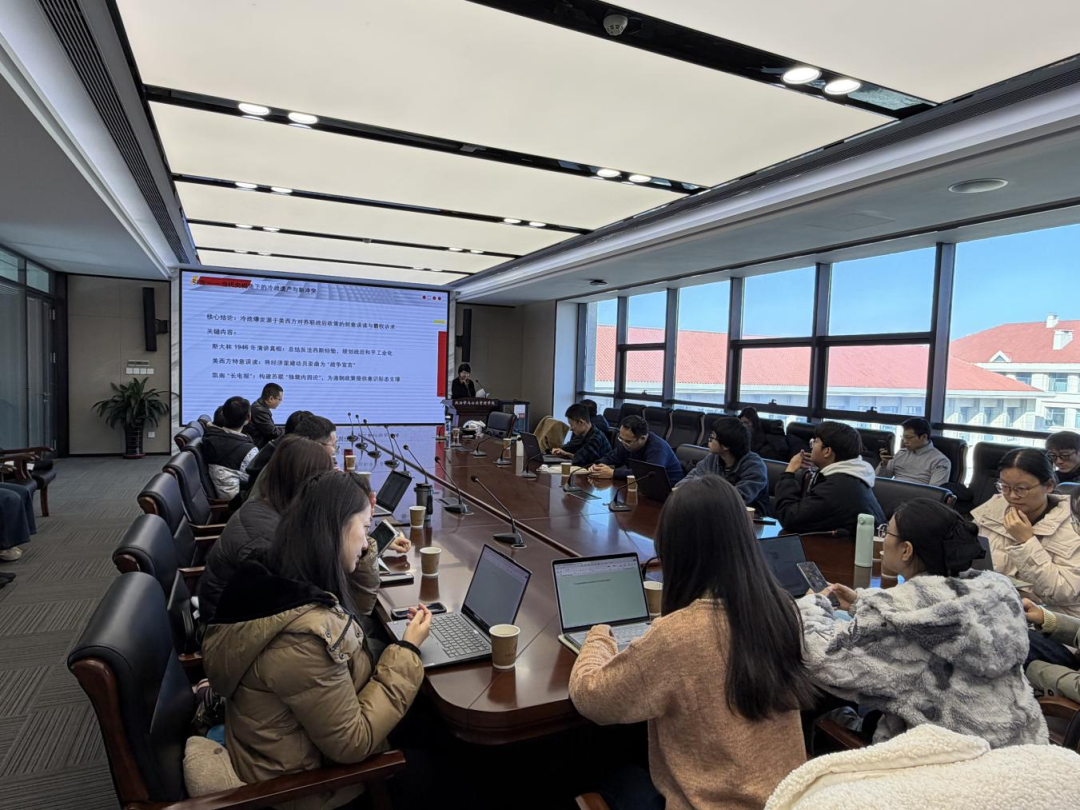
During the interactive exchange session, teachers and students raised questions on topics such as narrative competition in the Russia-Ukraine conflict, global communication governance, and major-country relations. Professor Lü Xinyu provided in-depth responses from three dimensions: communication politics, contemporary history, and international relations. She encouraged students to understand the construction mechanism of global conflict narratives from an interdisciplinary perspective, and to pay attention to the interactive relationship between historical memory, ideology, and power.
In his summary, Professor Edmund Sheng stated that Professor Lü Xinyu's report, which combines historical depth, theoretical sensitivity, and practical concern, provides an inspiring perspective for understanding changes in the international order and U.S. strategic behavior in the 21st century, and also expands new ideas for international communication and policy research within the framework of SCO studies.
This lecture has further enriched the construction of Shandong University's academic platform in global governance and international communication research. The School of Political Science and Public Administration and the SCO Research Institute of Shandong University will continue to launch high-level academic activities, providing an important channel for teachers and students to access cutting-edge international research and deepen interdisciplinary exchanges. All teachers and students are welcome to continue paying attention to the "Cooperation and Development" Lecture Series.